Why Human Connection Matters More in an AI World

Let me tell you what’s quietly happening while you’re busy optimizing your workflows.
Your most important career skill, the one that no algorithm can replicate, is atrophying. And most of us haven’t noticed, because the thing replacing it feels like connection. It has the shape of a connection. It’s just not the real thing.
I’m talking about our ability to build genuine human relationships at work.
I know. You’re busy.
So am I. And I’m not here to add to your to-do list. But I am here to name something I keep seeing in boardrooms, in coaching conversations, and in the data from our own research, and it concerns me enough that I need to share with you today.
We’ve been so focused on the efficiency gains from AI that we’ve started accidentally automating something that was never supposed to be automated: each other.
One AI-written email. One chatbot check-in. One templated reply at a time. We’re trading authenticity for convenience, and we’re calling it productivity.
Here’s what our data actually shows, and it’s heartbreaking. In our research at SkyeTeam, from more than 1,000 leaders who have completed their Ally Mindset™ Profile, more than 20% report having zero meaningful relationships at work. Not one coffee chat friend. Not one “how was your weekend?” in the hallway or via slack.
One leader confided to me recently: “We talk about collaboration, but the reality is siloed. I spend more time with spreadsheets than people—it’s efficient, but it’s lonely.”
That breaks my heart. And it should unsettle every leader reading this.
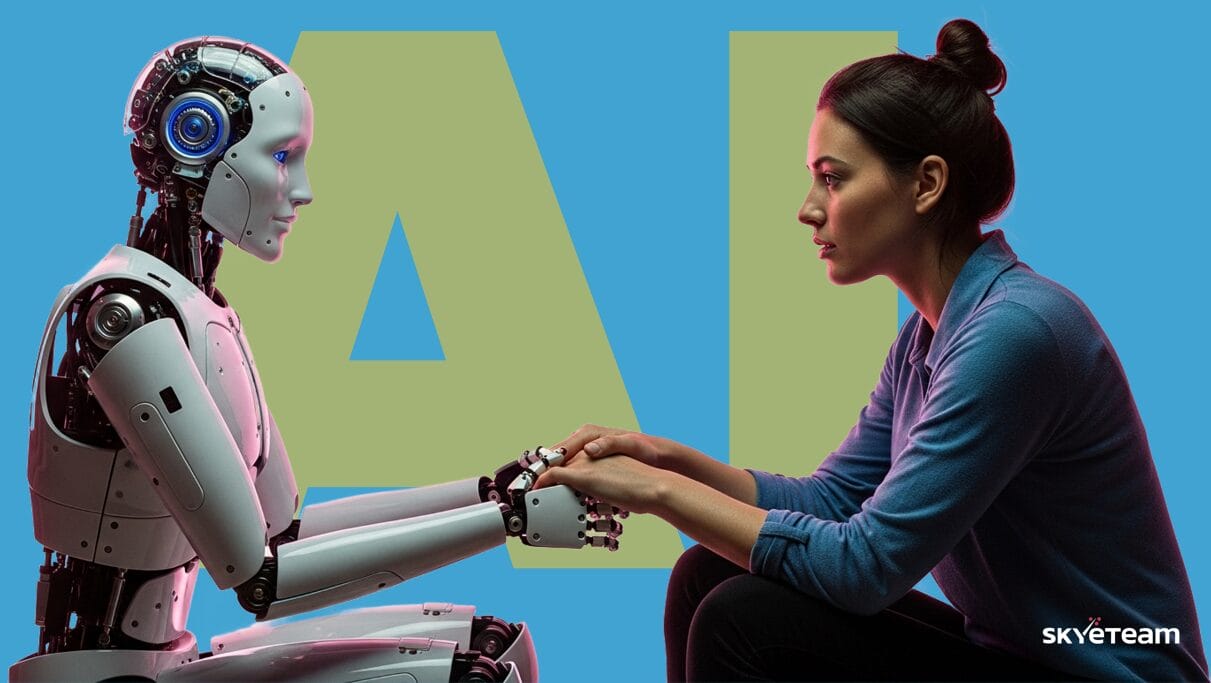
The thing about AI connection
Here’s the counterintuitive part: every advance in AI makes distinctly human skills more valuable, not less. AI can process data, generate content, and optimize processes at a scale no human can match. What it cannot do is build trust, read a room, or create the kind of psychological safety that actually makes teams work.
The problem is that AI connection is emotional fast food. Quick, convenient, designed to keep you coming back. But it leaves you hungrier than before.
When we get used to an AI that always agrees with us, never challenges us, never has a bad day, we start losing our appetite for the messy, imperfect, gloriously human work of a real relationship.
What I keep coming back to in my work, and what I’ve built my newest keynote around, is what I’m calling Meaning-FULL Connectivity™. Intentional moments of connection that actually fill you up rather than drain you dry. Not more meetings. Not more touchpoints. Connection that matters: with yourself, with your work, and with the people around you.
“But I’m not a people person.”
I hear this all the time. And I want to push back on it, gently but firmly (and sometimes not so gently and very firmly – IYKYK).
In 1995, “I’m not a computer person” was still a personality quirk. Now it’s a career liability. We’re at that same inflection point with relationships. The ability to build genuine human connections is no longer a soft skill or a nice-to-have; it is the fundamental skill of modern work.
Teams form fast across geographies and organizational lines, collaborate intensively, then dissolve and reform in new configurations. The people who thrive in that environment aren’t the ones who are best at competing with machines. They’re the ones who are best at working with other humans.
The blurry line we’ve been told to respect
We’ve all absorbed this idea that professional relationships should stay purely professional, that there’s a clear boundary between colleague and friend, between work and life, between “us” and “them.”
That idea is outdated.
We spend at least 40% of our waking hours with our colleagues. In many cases, we (should) know our coworkers better than our own neighbors. The relationships we build at work aren’t a distraction from the work, as I explore in You, Me, We, they are the work. They’re what determine whether information flows or stalls, whether people take risks or play it safe, and whether your best people stay or leave. The relationships are what make work and life fun!
Your network is your net worth. But not in the LinkedIn badge-collecting sense. I mean the real thing: relationships that can survive a job change, a reorg, or a hard conversation.
Building Real Human Connection: So What Do We Actually Do?
I’m not going to give you a ten-step framework here. (You can ask your AI bot for plenty of those.) What I will say is this:
If you’re using AI to free up time, the question worth asking is: what are you doing with that time? Are you using it to go deeper with the people around you? Or are you just filling it with more tasks?
The leaders I’m working with right now are asking themselves honest questions. Which relationships in my network would survive if I changed jobs tomorrow? Am I developing my emotional intelligence as intentionally as I upgrade my tech skills? Am I present in conversations, or am I already thinking about the next one?
These aren’t abstract questions. They’re the ones that determine whether you become indispensable in an AI-augmented world—or whether you become a very efficient, very isolated, very replaceable professional.
The good news? Every person can learn to build authentic human connection. Even, especially, if you don’t think you’re a people person.
Because in an AI world, being genuinely human isn’t just your competitive advantage.
It’s your survival strategy.
Curious where you stand? Take your Ally Mindset™ Profile to find out.
Frequently Asked Questions about Human Connection at Work
Why is human connection at work more important than ever?
Every advance in AI makes distinctly human skills more valuable, not less. AI can process data and optimise processes at a scale no human can match — but it cannot build trust, read a room, or create the psychological safety that makes teams actually work. In SkyeTeam’s research with more than 1,000 leaders, more than 20% report having zero meaningful relationships at work. That’s not a technology problem. It’s a human connection crisis that only humans can solve.
What is Meaning-FULL Connectivity™?
Meaning-FULL Connectivity™ is Morag Barrett’s framework for intentional human connection at work — moments of connection that actually fill you up rather than drain you dry. Not more meetings or more touchpoints, but connection that matters: with yourself, with your work, and with the people around you. It’s the antidote to the accidental automation of human relationships that’s quietly happening in most organisations right now.
How do you build genuine human connection in a hybrid or remote workplace?
Start by asking honest questions: which relationships in your network would survive if you changed jobs tomorrow? Are you developing your emotional intelligence as intentionally as you upgrade your technical skills? Are you present in conversations or already thinking about the next one? The leaders who thrive in hybrid environments aren’t the ones competing with machines — they’re the ones who are best at working with other humans.
Can you really learn to build better workplace relationships if you’re not a people person?
Yes — and this matters more now than it ever has. In 1995, “I’m not a computer person” was a personality quirk. Now it’s a career liability. We’re at the same inflection point with relationships. The ability to build genuine human connection is no longer a soft skill — it’s the fundamental skill of modern work. Every person can learn it. The Ally Mindset™ Profile is a good place to start.
Morag Barrett is a keynote speaker, executive coach, and USA Today bestselling author who helps leaders tackle one of today’s biggest workplace challenges: disconnection. Her work focuses on human connection at work, workplace relationships, employee engagement, and team culture — giving leaders practical tools to build trust and perform better together. Her signature keynote, Fine Is a Four-Letter Word, has been delivered to Fortune 500 companies and industry conferences worldwide. Member of Marshall Goldsmith’s 100 Coaches. Regular contributor to Fast Company.


Let's Connect